Bobby Darin Moods/swing: the Best of the Atlantic Years 1966-67 Download
| Bobby McFerrin | |
|---|---|
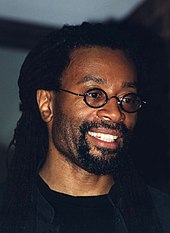
 McFerrin in 2011 | |
| Background information | |
| Birth proper name | Robert Keith McFerrin Jr. |
| Born | (1950-03-xi) March 11, 1950 Manhattan, New York, U.S. |
| Genres | Jazz, a cappella, vocal, globe, classical, vocal jazz |
| Occupation(south) | Musician, usher, arranger, producer |
| Instruments | Vocals, pianoforte, vocal percussion |
| Years active | 1970–present |
| Labels | Manhattan, Bluish Annotation, Elektra, Sony Classical |
| Associated acts | Chick Corea, Herbie Hancock, Yo-Yo Ma |
| Website | bobbymcferrin |
Robert Keith McFerrin Jr. (born March eleven, 1950)[ane] is an American folk-jazz vocalist. He is known for his song techniques, such equally singing fluidly but with quick and considerable jumps in pitch—for example, sustaining a melody while likewise rapidly alternate with arpeggios and harmonies—as well equally scat singing, polyphonic overtone singing, and improvisational vocal percussion. He is widely known for performing and recording regularly as an unaccompanied solo vocal artist. He has frequently collaborated with other artists from both the jazz and classical scenes.[2]
McFerrin's song "Don't Worry, Be Happy" was a No. 1 U.S. pop hit in 1988 and won Song of the Yr and Tape of the Year honors at the 1989 Grammy Awards. McFerrin has also worked in collaboration with instrumentalists, including pianists Chick Corea, Herbie Hancock, and Joe Zawinul, drummer Tony Williams, and cellist Yo-Yo Ma.[2]
Early on life and education [edit]
McFerrin was born in Manhattan, New York Urban center, U.s., the son of operatic baritone Robert McFerrin and singer Sara Copper. He attended Cathedral High School in Los Angeles,[3] Cerritos College,[four] Academy of Illinois Springfield (and so known as Sangamon State University)[5] and the California State University, Sacramento.[3]
Career [edit]
McFerrin's first recorded work, the self-titled anthology Bobby McFerrin, was non produced until 1982, when McFerrin was already 31 years old. Before that, he had spent six years developing his musical style, the first ii years of which he attempted not to heed to other singers at all, in order to avoid sounding like them. He was influenced by Keith Jarrett, who had achieved great success with a series of solo improvised piano concerts including The Köln Concert of 1975, and wanted to attempt something similar vocally.[6]
In 1984, McFerrin performed onstage at the Playboy Jazz Festival in Los Angeles as a 6th member of Herbie Hancock's VSOP II, sharing horn trio parts with the Marsalis brothers.
In 1986, McFerrin was the vocalization of Santa Bear in Santa Behave's Starting time Christmas, and in 1987 he was the vocalisation of Santa Carry/Bully Bear in the sequel Santa Bear's High Flying Hazard. On September 24 of that aforementioned twelvemonth, he performed the theme song for the opening credits of Flavor 4 of The Cosby Show.
In 1988, McFerrin recorded the vocal "Don't Worry, Be Happy", which became a hit and brought him widespread recognition across the globe. The song's success "ended McFerrin's musical life every bit he had known it," and he began to pursue other musical possibilities on stage and in recording studios.[7] The vocal was used every bit the official campaign song for George H. W. Bush-league in the 1988 U.S. presidential election, without Bobby McFerrin's permission or endorsement. In reaction, Bobby McFerrin publicly protested that use of his song, and stated that he was going to vote against Bush. He too dropped the song from his own operation repertoire.[8]
At that time, he performed on the PBS Tv special Sing Out America! with Judy Collins. McFerrin sang a Sorcerer of Oz medley during that telly special.
In 1989, he equanimous and performed the music for the Pixar brusk film Knick Knack. The crude cut to which McFerrin recorded his vocals had the words "blah blah apathetic" in identify of the end credits (meant to indicate that he should improvise). McFerrin spontaneously decided to sing "blah blah blah" equally lyrics, and the final version of the short moving-picture show includes these lyrics during the end credits. As well in 1989, he formed a ten-person "Voicestra" which he featured on both his 1990 album Medicine Music and in the score to the 1989 Oscar-winning documentary Mutual Threads: Stories from the Quilt.
Around 1992, an urban legend began that McFerrin had committed suicide; information technology has been speculated that the faux story spread because people enjoyed the irony of a man known for the positive bulletin of "Don't Worry, Exist Happy" suffering from depression in existent life.[nine]
In 1993, he sang Henry Mancini's "Pink Panther Theme" for the moving picture Son of the Pink Panther.
In add-on to his vocal performing career, in 1994, McFerrin was appointed as creative chair of the Saint Paul Bedchamber Orchestra. He makes regular tours as a guest usher for symphony orchestras throughout the U.s.a. and Canada, including the San Francisco Symphony (on his 40th birthday), the New York Philharmonic, the Chicago Symphony Orchestra, the Cleveland Orchestra, the Detroit Symphony Orchestra, the Israel Philharmonic Orchestra, the Philadelphia Orchestra, the Los Angeles Philharmonic, the London Philharmonic, the Vienna Philharmonic and many others. In McFerrin's concert appearances, he combines serious conducting of classical pieces with his ain unique vocal improvisations, often with participation from the audience and the orchestra. For case, the concerts oft end with McFerrin conducting the orchestra in an a cappella rendition of the "William Tell Overture," in which the orchestra members sing their musical parts in McFerrin's vocal style instead of playing their parts on their instruments.
For a few years in the tardily 1990s, he toured a concert version of Porgy and Bess, partly in honor of his father, who sang the function for Sidney Poitier in the 1959 picture show version, and partly "to preserve the score'south jazziness" in the face up of "largely white orchestras" who tend not "to play around the bar lines, to stretch and bend". McFerrin says that because of his father's work in the moving picture, "This music has been in my trunk for forty years, probably longer than any other music."[10]
McFerrin also participates in various music education programs and makes volunteer appearances as a guest music instructor and lecturer at public schools throughout the U.Due south. McFerrin has collaborated with his son, Taylor, on diverse musical ventures.
In July 2003, McFerrin was awarded an Honorary Doctorate of Music from Berklee College of Music during the Umbria Jazz Festival where he conducted two days of clinics.[11]
In 2009, McFerrin and psychologist Daniel Levitin hosted The Music Instinct, a two-60 minutes documentary produced by PBS and based on Levitin'south best-selling book This Is Your Encephalon on Music. Afterwards that year, the two appeared together on a console at the Earth Science Festival.
McFerrin was given a lifetime achievement accolade at the A Cappella Music Awards on May 19, 2018.
McFerrin was honored with the National Endowment for the Arts Jazz Masters award on August 20, 2020.
Personal life [edit]
He is the father of musicians Taylor McFerrin and Madison McFerrin, and player Jevon McFerrin.[12] [13]
Song technique [edit]
As a vocalist, McFerrin frequently switches chop-chop between modal and falsetto registers to create polyphonic effects, performing both the main tune and the accompanying parts of songs. He makes use of percussive effects created both with his mouth and by borer on his breast. McFerrin is likewise capable of multiphonic singing.[fourteen]
A certificate of McFerrin'southward approach to singing is his 1984 anthology The Phonation, the start solo song jazz album recorded with no accompaniment or overdubbing.[15]
Discography [edit]
Equally leader [edit]
- Studio albums
| Year | Anthology | Peak chart positions | Record label | ||||||||
|---|---|---|---|---|---|---|---|---|---|---|---|
| US [16] | U.s.a. R&B [16] | Usa Jazz [16] | US Cont. Jazz [16] | Britain [17] | |||||||
| 1982 | Bobby McFerrin | — | — | 41 | — | — | Elektra | ||||
| 1984 | The Voice | — | — | 24 | — | — | |||||
| 1986 | Spontaneous Inventions | 103 | 62 | half dozen | 2 | — | Blue Note | ||||
| 1988 | Uncomplicated Pleasures | five | 12 | — | 1 | 92 | EMI | ||||
| 1990 | Medicine Music | 146 | — | — | 2 | — | |||||
| 1992 | Play (with Chick Corea) | — | — | three | — | — | Blue Note | ||||
| Hush (with Yo-Yo Ma) | — | — | — | — | — | Sony Masterworks | |||||
| 1995 | Bang!Zoom | — | — | — | 10 | — | Blueish Annotation | ||||
| 1996 | The Mozart Sessions (with Chick Corea) | — | — | — | — | — | Sony Classical | ||||
| 1997 | Circlesongs | — | — | — | — | — | |||||
| 2002 | Beyond Words | — | — | — | 5 | — | Blue Note | ||||
| 2010 | Vocabularies | — | — | ii | — | — | EmArcy | ||||
| "—" denotes releases that did non chart or were not released in that territory. | |||||||||||
- Singles
| Year | Song | Pinnacle nautical chart positions | Certifications | ||||||||
|---|---|---|---|---|---|---|---|---|---|---|---|
| US Adult [18] | US R&B [18] | United states of america Hot 100 [18] | Great britain [17] [xviii] | Can [19] | |||||||
| 1982 | "Moondance / Jubilee" | ― | ― | ― | ― | ― | |||||
| "You've Really Got a Concord on Me" (with Phoebe Snowfall) | ― | ― | ― | ― | ― | ||||||
| 1988 | "Don't Worry, Exist Happy" | 7 | xi | 1 | 2 | i |
| ||||
| "Thinkin' About Your Body" | ― | ― | ― | 46 | ― | ||||||
| "Good Lovin'" | ― | ― | ― | ― | ― | ||||||
| 1990 | "The Garden" | ― | ― | ― | ― | ― | |||||
| "—" denotes releases that did not chart or were non released in that territory. | |||||||||||
As sideman [edit]
- Laurie Anderson, Foreign Angels, 1989
- Chick Corea, Rendezvous in New York, 2003
- Jack DeJohnette, Extra Special Edition (Blue Note, 1994)
- En Vogue, Masterpiece Theatre, 2000
- Béla Chip and the Flecktones, Piddling Worlds, 2003
- Chico Freeman, Tangents, 1984
- Gal Costa, The Laziest Gal in Town, 1991
- Dizzy Gillespie, Bird Songs: The Final Recordings (Telarc, 1992)
- Airheaded Gillespie, To Bird with Beloved (Telarc, 1992)
- Herbie Hancock, Round Midnight, 1986
- Michael Hedges, Watching My Life Get Past, 1985
- Al Jarreau, Heart'south Horizon, 1988
- Quincy Jones, Back on the Cake, 1989
- Charles Lloyd Quartet, A Night in Copenhagen (Bluish Note, 1984)
- The Manhattan Transfer, Vocalese, 1985
- Wynton Marsalis, The Magic Hour, 2004
- George Martin, In My Life, 1998
- W.A. Mathieu, Available Light, 1987
- Modern Jazz Quartet, MJQ & Friends: A 40th Anniversary Celebration (Atlantic, 1994)
- Pharoah Sanders, Journeying to the I (Theresa, 1980)
- Grover Washington Jr., The All-time Is Yet to Come, 1982
- Weather Report, Sportin' Life, 1985
- Yellowjackets, Dreamland, 1995
- Joe Zawinul, Di•a•lects, 1986
Grammy Awards [edit]
- 1985, Best Jazz Vocal Operation, Male for "Another Dark in Tunisia" with Jon Hendricks from the album Vocalese.
- 1985, Best Vocal Arrangement for Two or More than Voices, "Another Night in Tunisia" with Cheryl Bentyne.
- 1986, Best Jazz Vocal Performance, Male person, "Circular Midnight" from the soundtrack album Round Midnight.
- 1987, Best Jazz Vocal Performance, Male, "What Is This Thing Called Dearest" from the album The Other Side of Round Midnight with Herbie Hancock.
- 1987, All-time Recording for Children, "The Elephant'south Child" with Jack Nicholson.
- 1988, Song of the Year, "Don't Worry, Be Happy" from the anthology Simple Pleasures.
- 1988, Record of the Year, "Don't Worry, Be Happy" from the anthology Simple Pleasures.
- 1988, Best Pop Vocal Performance, Male, "Don't Worry, Be Happy" from the album Simple Pleasures.
- 1988, Best Jazz Song Performance, "Brothers" from the album Duets past Rob Wasserman.
- 1992, All-time Jazz Song Operation, "Round Midnight" from the album Play.
References [edit]
- ^ Larkin, Colin, ed. (May 27, 2011). Encyclopedia of Popular Music (5th Concise ed.). Bus Printing. pp. 1978–1980. ISBN978-0-8571-2595-8.
- ^ a b Ankeny, Jason. "Artist Biography". AllMusic . Retrieved January 22, 2022.
- ^ a b North, Cheryl (November 17, 2014). "Jeremy Denk, Bobby McFerrin: Two talented wits bring their music to San Francisco". The Mercury News. San Jose. Retrieved October 21, 2020.
- ^ Epstein, Benjamin (August 23, 1996). "McFarrin Well". Los Angeles Times . Retrieved Jan 23, 2022.
- ^ "History and Traditions - About". University of Illinois Springfield . Retrieved January 23, 2022.
- ^ "Bobby Solo". Bobby McFerrin Official Website.
- ^ "Bobby McFerrin's Improv-Inspired 'Vocabularies'". [{Weekend Edition]]. NPR. Retrieved January 23, 2022.
- ^ "The Repeat & Racket of George Bush'south 1988 Campaign Music". Carl Anthony Online. Oct 13, 2012. Archived from the original on November xiv, 2012. Retrieved Nov 12, 2012.
- ^ Mikkelson, David. "Bobby McFerrin Suicide Rumor". Snopes . Retrieved July 1, 2011.
- ^ Ellison, Cori (Dec 13, 1998). "'Porgy' and Music's Racial Politics". The New York Times.
- ^ Carlson, Russell (June 21, 2003). "Berklee Honors Rollins, Holds Summer Clinics". JazzTimes.
- ^ Allen, Meaghan (July 10, 2017). "Madison McFerrin: a cappella with a twist". B-Side . Retrieved May nine, 2021. [ dead link ]
- ^ Bream, Jon (June 12, 2018). "Returning to Minnesota, Grammy-winner Bobby McFerrin gives get-go interview in four years". Star Tribune. Minneapolis. Retrieved Jan 23, 2022.
- ^ "Jazz, at Ritz, McFerrin". The New York Times. December 12, 1984.
- ^ Yanow, Scott. "Bobby McFerrin – The Vocalism - AllMusic Review".
- ^ a b c d "Bobby McFerrin - Awards". AllMusic. Archived from the original on November 19, 2012. Retrieved January 22, 2022.
- ^ a b "BOBBY MCFERRIN - total Official Chart History". Official Charts Visitor . Retrieved Jan 22, 2022.
- ^ a b c d "Bobby McFerrin Superlative Songs / Chart Singles Discography". Music VF . Retrieved December 27, 2021.
- ^ "Don't Worry, Be Happy in Canadian Height Singles Chart". Library and Archives Canada. Archived from the original on June 21, 2017. Retrieved Dec 27, 2021.
- ^ "Bobby McFerrin - Don't Worry Be Happy". British Phonographic Industry . Retrieved January 22, 2022.
External links [edit]
- Bobby McFerrin official website
- Bach & Friends documentary
DOWNLOAD HERE
Posted by: cohenandints42.blogspot.com

Post a Comment for "Bobby Darin Moods/swing: the Best of the Atlantic Years 1966-67 Download"